2Pamukkale University, Department of Child and Adolescent Psychiatry, Denizli, Turkiye
3Balikesir University, Department of Child and Adolescent Psychiatry, Balikesir, Turkiye
Abstract
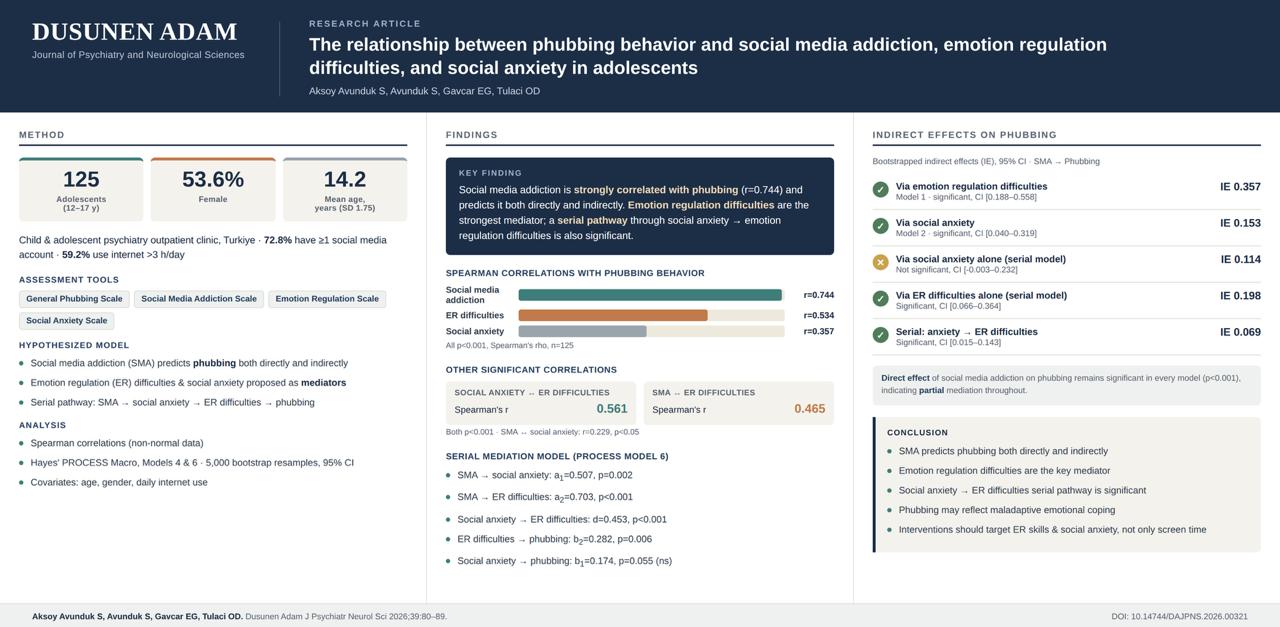
Objective: Phubbing—defined as the act of ignoring people in one’s physical environment in favor of engaging with a smartphone— has become increasingly prevalent among adolescents. While social media use is often central to this behavior, the psychological mechanisms underlying phubbing remain insufficiently explored. This study aimed to investigate the relationships between phubbing behavior, social media addiction, emotion regulation difficulties, and social anxiety in adolescents. It was hypothesized
that social media addiction would predict phubbing both directly and indirectly through emotional and social factors.
Methods: The sample consisted of 125 adolescents aged 12–17 years who attended a child and adolescent psychiatry outpatient clinic in Turkiye. Standardized self-report measures were used to assess phubbing behavior, social media addiction, emotion regulation difficulties, and social anxiety. Correlation and mediation analyses were conducted using SPSS and Hayes’ PROCESS Macro (Models 4 and 6), with 5,000 bootstrap resamples applied to test indirect and serial effects.
Results: Social media addiction, emotion regulation difficulties, and social anxiety were all positively and significantly associated with phubbing behavior. Mediation analyses indicated that both social anxiety and emotion regulation difficulties partially mediated the relationship between social media addiction and phubbing. The serial mediation model further suggested that social media addiction may be linked to phubbing through increased social anxiety and subsequent emotion regulation difficulties.
Conclusion: These findings highlight a potential interplay between digital habits and emotional functioning in adolescents. Phubbing may be understood not only as a behavioral outcome of digital engagement but also as a maladaptive coping strategy shaped by emotional vulnerabilities. Preventive interventions targeting emotion regulation and social media use may help reduce phubbing-related social difficulties.
Graphical Abstract