Abstract
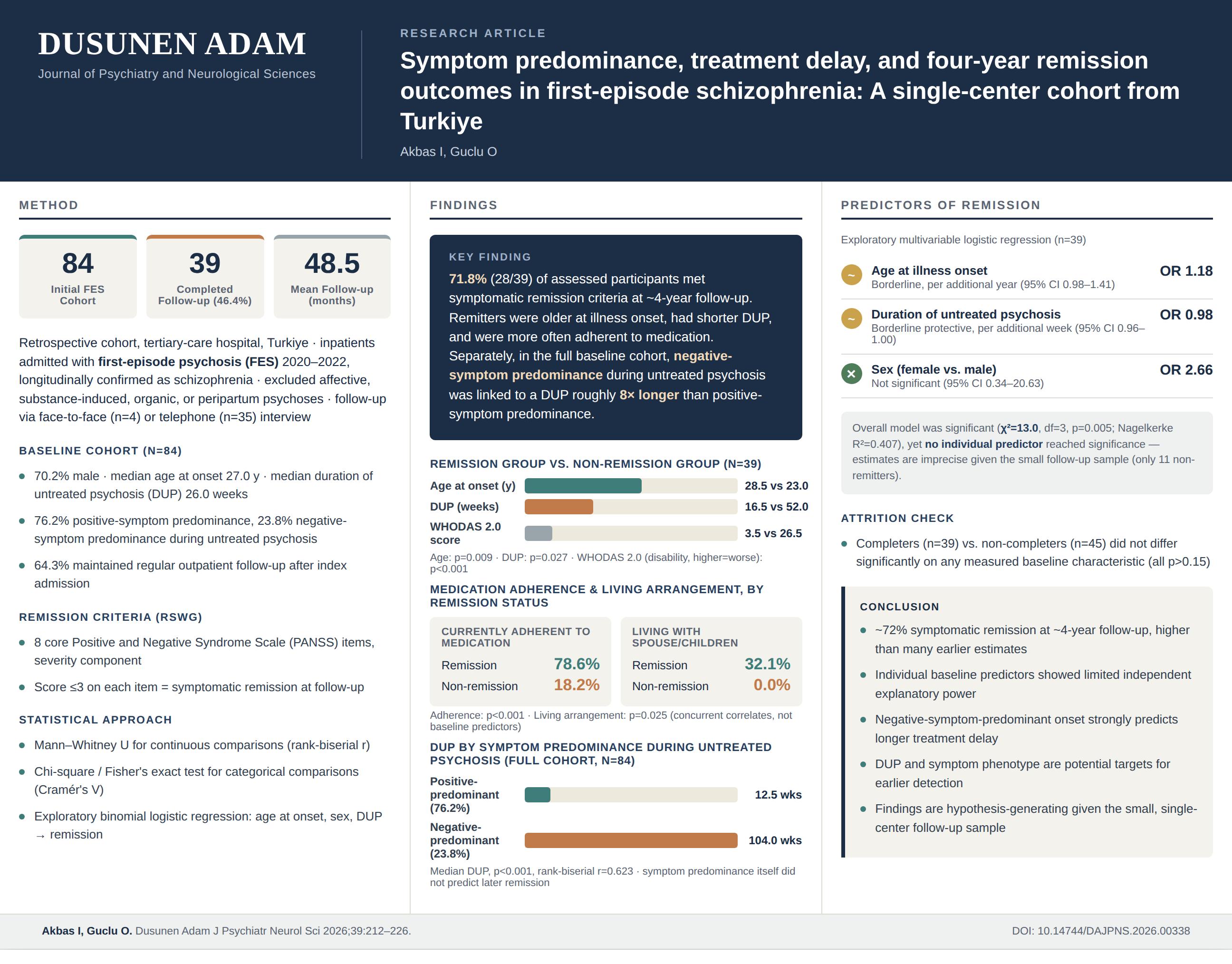
Objective: This study aimed to estimate the rate and baseline predictors of symptomatic remission and to examine the association between symptom predominance during the untreated psychosis period and its duration in a diagnostically homogeneous cohort of individuals with first-episode schizophrenia treated under routine clinical conditions in Turkiye.
Methods: This retrospective cohort study included 84 inpatients admitted with first-episode psychosis between 2020 and 2022 who subsequently received a longitudinally confirmed diagnosis of schizophrenia. Patients with affective, substance-induced, organic, or peripartum psychoses were systematically excluded. Follow-up assessments were completed for 39 participants (46.4%) after a mean follow-up of 48.5 months. Cross-sectional symptomatic remission was assessed according to the severity component of the Remission in Schizophrenia Working Group criteria using the eight specified Positive and Negative Syndrome Scale (PANSS) items. Exploratory associations between selected baseline variables and remission were examined using binomial logistic regression, and the association between symptom predominance (positive vs. negative) during the untreated psychosis period and duration of untreated psychosis (DUP) was examined in the full baseline cohort.
Results: At follow-up, 71.8% (28/39; 95% confidence interval, 56.2%–83.5%) of the 39 assessed participants met the symptomatic remission criterion. Remitters had a significantly older age at illness onset and shorter DUP than non-remitters; current living arrangement and medication adherence also differed significantly between groups. An exploratory multivariable logistic regression model including age at illness onset, sex, and DUP was significant overall (p=0.005), although no individual variable reached statistical significance. In the full baseline cohort (n=84), negative-symptom predominance during the untreated psychosis period was associated with a markedly longer DUP than positive-symptom predominance (median, 104.0 vs. 12.5 weeks; p<0.001).
Conclusion: Symptomatic remission was common approximately four years after first admission, although individual baseline predictors showed limited independent explanatory power in this modestly sized cohort. Negative-symptom predominance during the untreated psychosis period was strongly associated with prolonged treatment delay, highlighting a potential target for earlier detection efforts.
Graphical Abstract