2Batman Iluh State Hospital, Department of Child and Adolescent Psychiatry, Batman, Turkiye
3Istanbul University Faculty of Medicine, Department of Child and Adolescent Psychiatry, Istanbul, Turkiye
Abstract
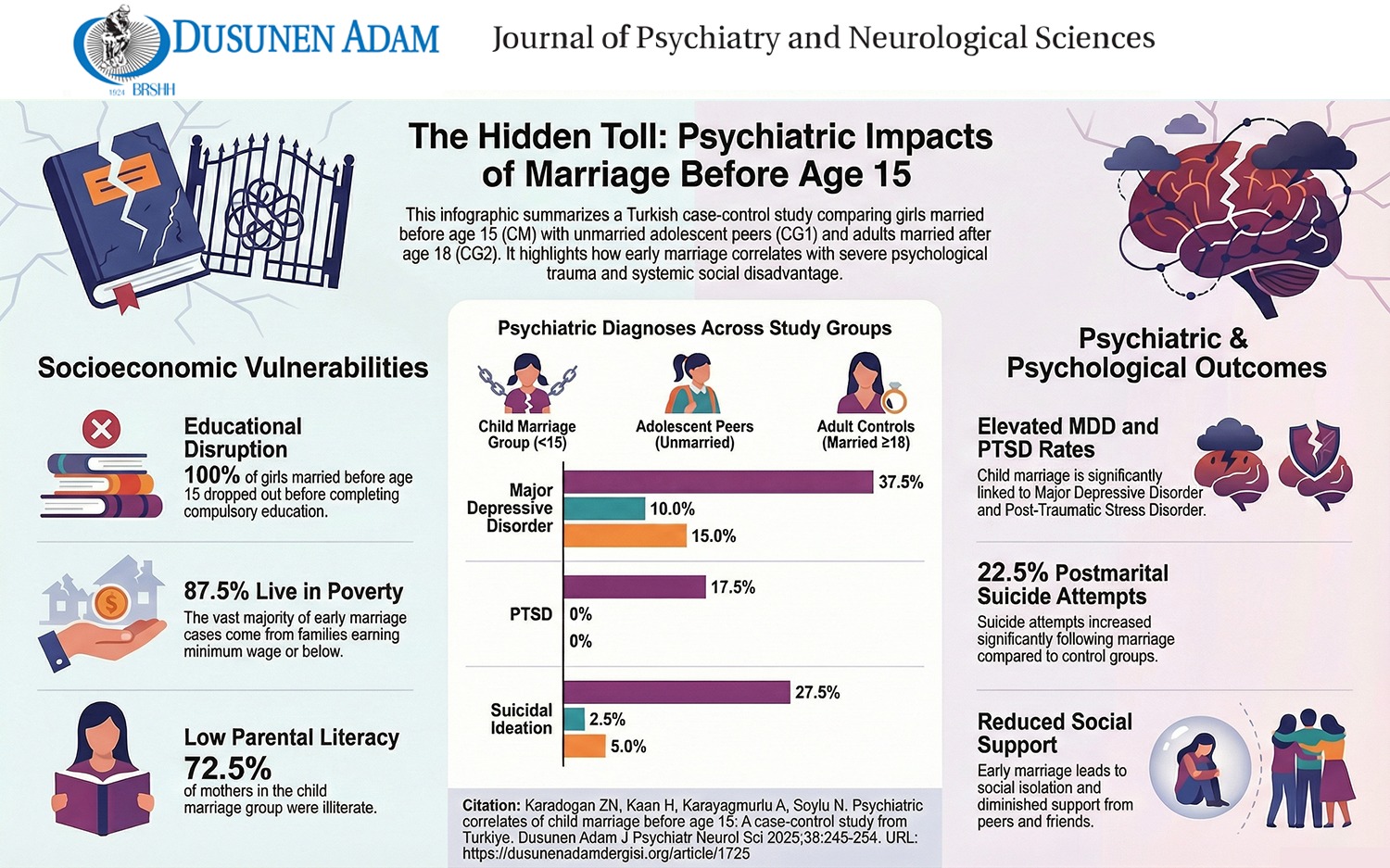
Objective: Child marriage gives rise to a wide range of problems for young girls whose psychosocial development is incomplete at the time of marriage. The objective of this case-control study is to compare a sample of girls who married at an early age with two control groups (i.e., unmarried peer adolescents and adults who married after 18 years of age) in terms of sociodemographic characteristics and psychiatric diagnoses.
Methods: A total of 120 female participants were included: the child marriage group (CM; n=40), adolescent peers (CG1; n=40), and adults married at ≥18 years (CG2; n=40). Psychiatric diagnoses were assessed using the Schedule for Affective Disorders and Schizophrenia for School-Age Children – Present and Lifetime Version (K-SADS-PL). Participants completed the Beck Depression Inventory, Brief Symptom Inventory, State-Trait Anxiety Inventory I-II, Coopersmith Self-Esteem Inventory, and Multidimensional Scale of Perceived Social Support.
Results: The CM group exhibited higher rates of lower parental education, lower family income, and a greater prevalence of extended/fragmented family structure compared with both control groups (p<0.05). The CM group also showed significantly higher rates of major depressive disorder (MDD) and post-traumatic stress disorder (PTSD) compared with CG1 (p=0.022; p=0.012) and CG2 (p=0.004; p=0.012). Postmarital suicide attempts were more prevalent in the CM group than in the CG2 group (p=0.002).
Conclusion: Child marriage was associated with lower socioeconomic and educational status, a higher prevalence of MDD and PTSD, lower self-esteem, lower perceived social support, and higher rates of suicidal behavior. These findings underscore the importance of preventive strategies, targeted mental health interventions, and strengthened social support systems for girls at risk of early marriage.
Graphical Abstract